
Subject line generation, send-time optimization, propensity scoring, next-best-action, creative variants. Practically every marketing team has adopted AI in some form (or several) over the last two years. The tooling is everywhere.
The results are not.
For some teams, the lift showed up once, early, and then flattened. The models keep running. The reports keep coming. The numbers stop moving. And the natural conclusion is that the LLM just isn’t very good yet.
On a recent episode of Total Retail Tech Insights, host Joe Keenan sat down to take that conclusion apart with Eugene Yukin, Vice President of Product here at MessageGears. Eugene has spent 15+ years building martech and personalization products across startups and Fortune 1000 companies, and his read on the AI plateau is blunt: the model is rarely the constraint. The data feeding it almost always is.

Adoption went up. ROI went sideways.
The divide between AI adoption and AI return is a gap many leaders are stuck in right now and struggle to close. Budgets moved. Vendors delivered. Teams are using the right features. And yet the measurable improvement in revenue per send, in retention, in campaign efficiency, it’s all thinner than the investment implied it would be.
Eugene’s framing is that AI in marketing is being asked to reason over a picture of the customer that’s incomplete, out of date, or locked inside a system it can’t reach. A model given that partial picture will still produce a confident output. It won’t produce smarter output, though, and it won’t get better over time, because nothing in the loop is teaching it anything new.
That’s the difference between an AI solution and an AI system. One runs. The other learns.
Three ways engagement data gets stuck
The failure modes Eugene describes aren’t exactly revolutionary. They show up in nearly every enterprise stack.
Siloed. Email engagement lives in the ESP. Web behavior lives in the analytics platform. Purchase history lives in the warehouse or the commerce system. Support interactions live somewhere else entirely. Each solution holds a partial view, and none of them hold a cohesive customer profile. An AI model pointed at any one of those silos is optimizing against a fragment.
Stale. Even when the data does get consolidated, it usually arrives on a batch schedule. A nightly sync means the model is reasoning over yesterday. In retail, where intent windows can close in an afternoon, yesterday is often too late to be useful. The output looks personalized, but it’s personalized to a customer who has already moved on.
Trapped. This is the one that quietly costs the most. Engagement data generated by the marketing platform (opens, clicks, conversions, suppression signals) often stays inside that platform. It never flows back into the warehouse or the other data sources where the rest of the customer picture lives. So the single richest signal about what’s actually working never reaches the systems that could learn from it.
Fix the third one, and the first two get easier to solve. The two-way feedback loop with your central database is what turns a static dataset into an intelligent system that compounds.
The feedback loop is the product
The practical version of Eugene’s argument is that AI gets smarter when engagement outcomes land back in the same place the segmentation and personalization decisions are made, and they have to get there fast enough to matter.
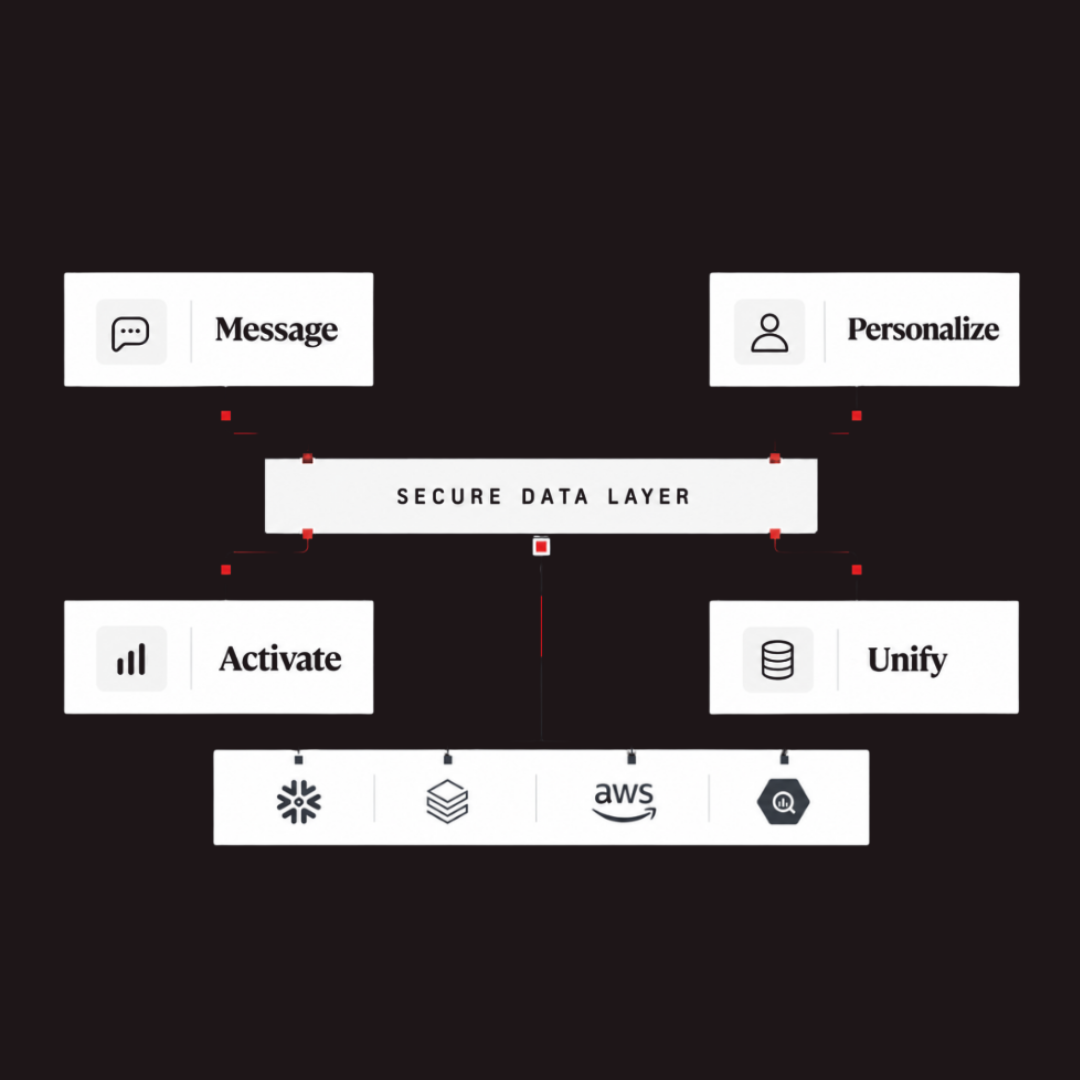
That’s an architecture fix, not a feature fix. If your marketing platform holds its own copy of your audience and keeps its own engagement data hostage, you have two datasets (at least) that will never fully reconcile. And your AI model likely only sees one of them at a time. Instead, if the marketing platform connects directly to your data sources and automatically writes campaign results back, the loop closes. Every tactic becomes a training signal for the next one.
This is the design principle behind the MessageGears cross-channel marketing platform: query your customer data where it already lives, activate against it in real time, and return engagement data to the same central environment the rest of your org works from. This way, every next decision is better informed than the last. Enterprises like Chewy and Sherwin-Williams run cross-channel programs on that model with us today.
The MessageGears architecture is purpose-built to handle real-time data and enterprise message deployment at scale.
Security is not the tradeoff people assume
Whenever the conversation turns to making customer data more accessible, security becomes the immediate objection, and reasonably so. More movement means more exposure.
Eugene’s point on the podcast is that this objection assumes data replication is required. The reason some enterprise datasets feel too risky to activate is because this used to mean exporting it into a third-party vendor environment outside the company’s control. But remove the copy, and the risk profile changes. Data that stays inside your firewall, governed by your existing controls, is more available to marketing and less exposed at the same time. Those two goals only conflict when the architecture forces a duplicate. More on how that works in practice: inside the MessageGears data security model.
The same logic applies to cost. Duplicate storage is a line item. So is the egress cost to move it, and the compute spent re-syncing it. Teams that consolidate on their own data sources tend to find that the AI question and the cost question have the same answer.
What actually speeds up
The reason this matters beyond the marketing org is speed of decisioning.
When customer data is accessible in real time and engagement results flow back into it, the cycle time on a decision drops from weeks to hours. A merchandising question, a pricing test, an inventory-driven promotion, all of them stop waiting on a data pull. Eugene describes this as the underrated return on fixing data architecture. You don’t just get better campaigns, but a business that can respond to the market at the speed the market moves.
Three things to do this quarter
Eugene closed the episode with concrete next steps, and they’re worth running as an exercise even if you aren’t evaluating platforms right now.
- Audit your data latency. Not just whether you have the data, but how old it is at the moment a campaign decision uses it. Measure the gap between when a signal is created and when a marketer (human or agent) can act on it. The number is usually worse than the team expects.
- Interrogate your AI admin about context. Ask what data the model is trained on, what it can see at decision time, and whether each customer engagement data point is shared in a usable form or held inside a siloed platform. A martech vendor that cannot answer the third question clearly is selling you a feature, not a system.
- Run one feedback loop experiment. Pick a single program and close the loop on it. Get engagement outcomes back into your primary data source, and let the next AI modeling cycle use them. Measure the delta. One working campaign loop with tangible results will make your internal case for why this matters much better than any deck can.
Listen to the full conversation
The full episode, Why Your Marketing AI Isn’t Getting Any Smarter: Reshaping Data Architecture with MessageGears, is available on Total Retail Tech Insights.
To see what closing the cross-channel loop looks like against your own data sources, get a demo.