
I’m on the floor at Databricks Data + AI Summit this week. Yesterday, I watched CEO Ali Ghodsi take the stage and announce CustomerLake, an agentic CDP built natively inside the Databricks lakehouse.
My initial reaction? Vindication.
Hearing it first-hand felt like finally being affirmed for what MessageGears has been saying for years.
This announcement is a turning point for the martech industry – but it’s not the turning point some people think it is.
The CDP as middleware is dying
The loudest takes since yesterday have been about CDPs vs. Databricks, composable vendors scrambling to reposition, and what this means for the Brazes and Iterables of the world. That framing misses the bigger story.
Tasso Argyros, who runs CustomerLake for Databricks, said it plainly in AdWeek: “I think the CDP, as middleware, is going to go away.” Alex Dean, CEO of Snowplow, put it this way: “the interesting frontier is no longer just about where customer data lives. It’s about what AI agents do with that data — in real time, in the moment, on behalf of customers and businesses alike.”
They’re both right. The question is: who’s actually positioned to execute on that future?
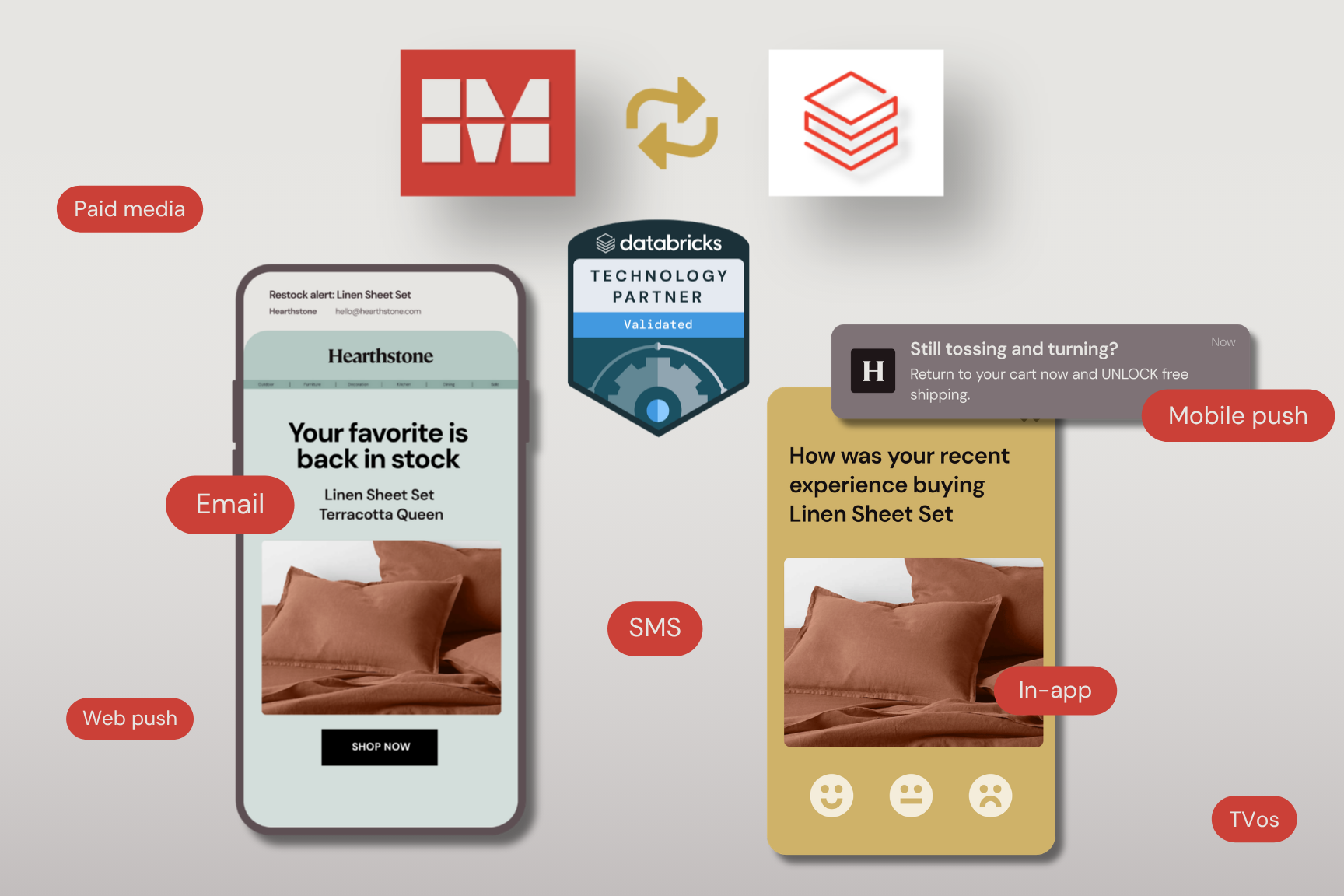
MessageGears is a Validated Partner of Databricks, and we’ve spent over a decade building the only cross-channel marketing platform that activates and deploys messaging natively, right from a customer’s own data source. We didn’t pivot to warehouse-native when it became fashionable. It’s been our architecture from day one (although some other vendors that came along later have claimed to have invented the idea).
So when one of the largest data and AI companies in the world takes the stage and declares that marketing execution belongs in the warehouse, MessageGears is far from threatened. We’re excited.
What CustomerLake actually is (and what it isn’t)
CustomerLake is a genuinely impressive product vision. Profile Agents unify raw customer data into governed Customer 360 profiles natively inside Databricks. Campaign Agents build audiences, recommend next-best actions, and optimize continuously around business goals. Databricks calls the output “infinity campaigns” — always-on loops that analyze, decide, and act in real time.
Matthew Niederberger, one of the sharpest independent analysts in martech, summed it up well: “CustomerLake is a marketing application that lives on the lakehouse instead of beside it.” That’s the right frame. Every CDP before it was, in some sense, a copy of your data with a marketing interface on top. CustomerLake is the marketing interface on the data itself.
But here’s what the keynote glosses over: CustomerLake doesn’t send messages. It doesn’t execute cross-channel campaigns. For actual delivery, it hands off to partners — Braze, Iterable, and others listed in the announcement.
Databricks built the intelligence layer. They deliberately left the execution layer to the ecosystem.
That’s not a knock. It’s a design decision, and a smart one. But it means CustomerLake is, by definition, incomplete without a cross-channel execution partner. And not all execution partners are created equal.
The gap that still exists (and why it matters)
Braze and Iterable are good platforms. They’re also built on a fundamentally different architectural assumption: that marketing data needs to live inside their system. To use them with CustomerLake, you still need to move data — or at minimum, sync profiles and audiences — out of the data lake and into their cloud.
That sync is where intelligence goes stale. That’s where the ML model scores that live in your central dataset become the attribute snapshot that arrived in your ESP six hours ago. That’s where “warehouse-native decisioning” starts to look a lot like the architecture it was supposed to replace.
MessageGears doesn’t work that way. Our platform runs natively inside the customer’s data source — Databricks, Snowflake, BigQuery, etc. — without needing to move, copy, or store a duplicate profile. When a journey step fires, it queries the warehouse directly. The ML model score your data science team updated this morning is available to the campaign running in 15 minutes. The transactional history, the behavioral signals, the computed fields — all of it, at every step, from the source.
And today, we announced something that makes the combination even more powerful: MessageGears Journeys — a fully reimagined visual journey orchestration canvas built on data-native architecture, designed for the AI-driven future Databricks just described from the keynote stage.
We rebuilt orchestration because the future demanded it
Journey builders have existed for… a long time now.
We didn’t build a new one because the category needed another drag-and-drop campaign canvas. We rebuilt orchestration from the ground up because AI is fundamentally changing how customer journeys are designed and managed.
Marketers need a tool that can work with their growing army of agents – a tool that doesn’t make them want to rip their hair out at every step.
MessageGears architected data-native journeys so that AI agents (administered by marketing teams) can select the right execution path for every campaign flow based on the actual trade-offs that matter: personalization depth, latency, and compute cost. Warehouse-native journeys for high-value, data-rich flows that require the full depth of your customer intelligence. Hybrid journeys when real-time event-triggered entry is genuinely required. Cloud-based journeys when sub-second latency is the hard constraint.
The intelligence for those decisions — the model scores, the behavioral signals, the identity resolution — already lives in your Databricks environment. MessageGears is the execution layer that turns it into action, step by step, right where it lives.
This is what CustomerLake’s partner ecosystem is supposed to provide. The difference is that we do it without the data needing to leave your lakehouse.
What this moment means for enterprise leaders
If you’re a marketing or data leader, the CustomerLake announcement is a signal worth taking seriously — not because Databricks is your new marketing platform, but because the largest data company in the world just told you that the future of marketing execution is warehouse-native.
Gartner predicts that by 2030, 80% of net-new enterprise CDP deployments will be embedded in or composable with data platforms. If you’re still evaluating a standalone CDP on a multi-year contract, CustomerLake just changed that math.
But the decision doesn’t stop at the intelligence layer. You still need an execution layer that can actually deliver on the personalization CustomerLake is designed to unlock. If that execution layer requires copying your data out of the lakehouse first, you’ve already compromised the architecture you just paid to build.
The combination of Databricks CustomerLake and MessageGears gives enterprise teams something genuinely new: governed, AI-ready customer intelligence in a centralized dataset, and cross-channel execution that doesn’t force that intelligence to move. No syncs. No stale profiles. No second system to reconcile.
That’s not a partnership pitch. It’s the logical conclusion of an architecture that both companies have been building toward — from different directions, for years.
Centralized data has won – now the question is what you build on it
I’ve spent 12 years at MessageGears watching the martech industry slowly arrive at conclusions we built our company around. Data shouldn’t move to marketing. Marketing should move to the data.
Databricks said that from one of the biggest stages in enterprise tech this week. The market is listening.
If you’re at Data + AI Summit, come find us — MessageGears is a sponsor this year and would love to talk through what this moment means for your stack. Or if you’re ready to see what data-native journey orchestration looks like in practice, request a demo and we’ll get you on the books with an expert.