
- The root cause of sub-par orchestration that most vendors don’t discuss
- Limitation #1: Personalization stops at what’s been synced
- Limitation #2: Audience segmentation breaks down at enterprise complexity
- Limitation #3: Journey triggers depend on stale data
- Limitation #4: Analytics live in the vendor’s cloud, not yours
- Limitation #5: Experimentation requires rebuilding, not iterating
- Limitation #6: Marketers depend on engineers for too much
- What overcoming the status quo actually looks like
Enterprise marketing teams have an overwhelming number of journey orchestration platforms to choose from. And yet, the same complaints keep surfacing. Personalization that falls flat. Segmentation that can’t keep up with complex logic. Analytics that don’t match what the data team sees.
But the tools aren’t broken. They’re just built on a foundation that creates ceilings – and most vendors talk around that.
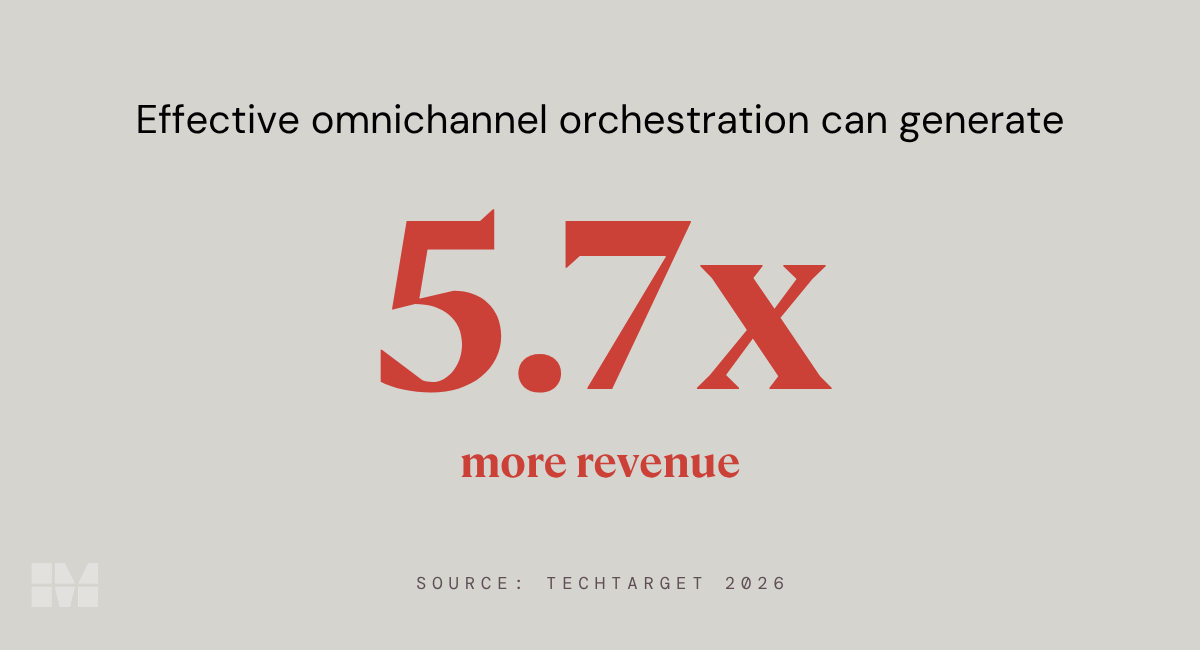
This article breaks down the most common limitations of omnichannel journey automation tools and explains why those limitations aren’t bugs to be patched. Your problems are likely structural, and overcoming them requires a fully modernized approach. And the upside potential is huge. When done right, great omnichannel experiences can increase revenue by more than 5x.
The root cause of sub-par orchestration that most vendors don’t discuss
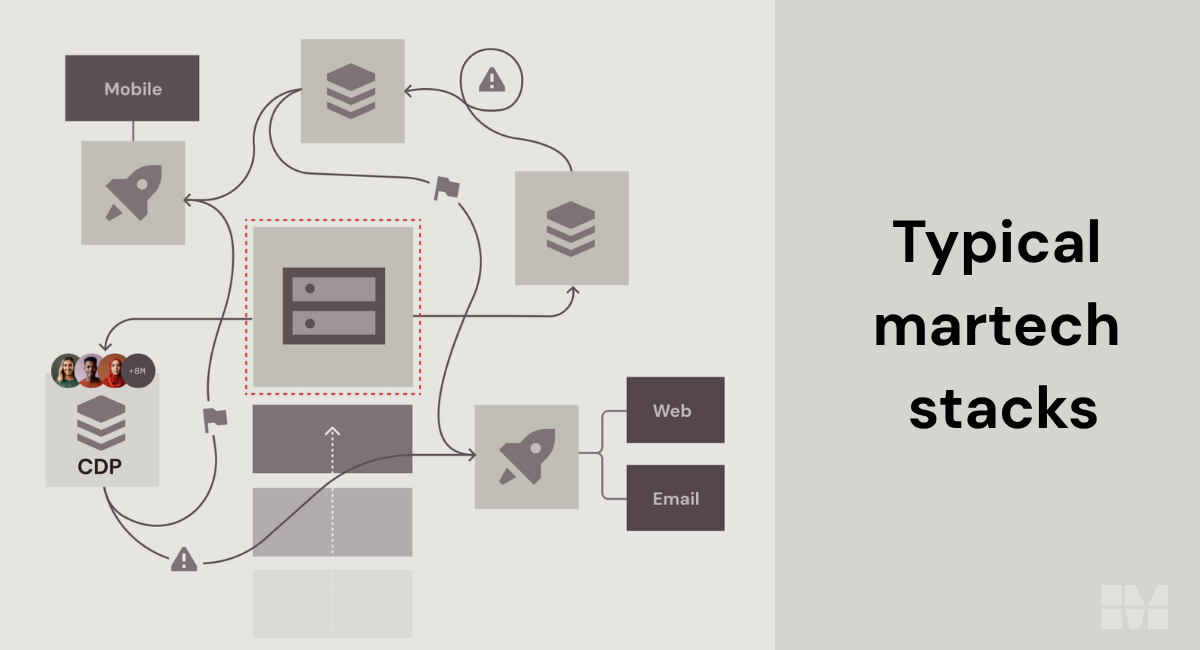
Before getting into specific roadblocks that marketers run into when designing journeys, it helps to understand that nearly every major omnichannel orchestration platform on the market operates the same way. They ingest a copy of your customer data, store it in their own cloud, and run journey logic against that copy.
On the surface, that sounds fine. In practice, it can create a cascade of problems – especially at the enterprise level where marketing programs get complex, fast.
The synced data is never fully current. It’s never complete. It carries egress costs, governance exposure, and a persistent gap between what your data team knows and what your marketing tool can act on. Every limitation described below traces back to this underlying architecture issue.
Limitation #1: Personalization stops at what’s been synced
Ask most journey automation platforms what data they can personalize against, and they’ll give you a confident answer: anything in their system. What they can be less forthcoming about is how data gets into their system in the first place – through syncs, imports, custom streams, and pipelines that capture a pre-approved slice of your customer profiles.
That means personalization stops at whatever fields someone decided were worth syncing over for the marketing team. This often leaves out a lot of crucial intel like ML model scores, computed attributes, operational records, and certain real-time behavioral events. If those aren’t included in the data pipeline, you’re not available to leverage any of it when building a customer journey.

For enterprise brands running sophisticated programs, this creates a real ceiling to the journeys you can create. The signals that make personalization actually feel personal — loyalty tiers, predicted LTV, product affinity scores, post-purchase behaviors – all live in the warehouse. Martech that can’t reach the full dataset are always working with an incomplete picture.
The alternative: A warehouse-native journey orchestration platform that queries your warehouse data directly, in-place. Every column, table, and computed field is in scope at every step — not just the subset that made it through a sync.
Limitation #2: Audience segmentation breaks down at enterprise complexity
The audience builders in most omnichannel journey automation tools are designed for accessibility, not depth. Point-and-click interfaces handle simple criteria well: customers in a specific region, customers who opened an email in the last 30 days, customers with a purchase in the last quarter.
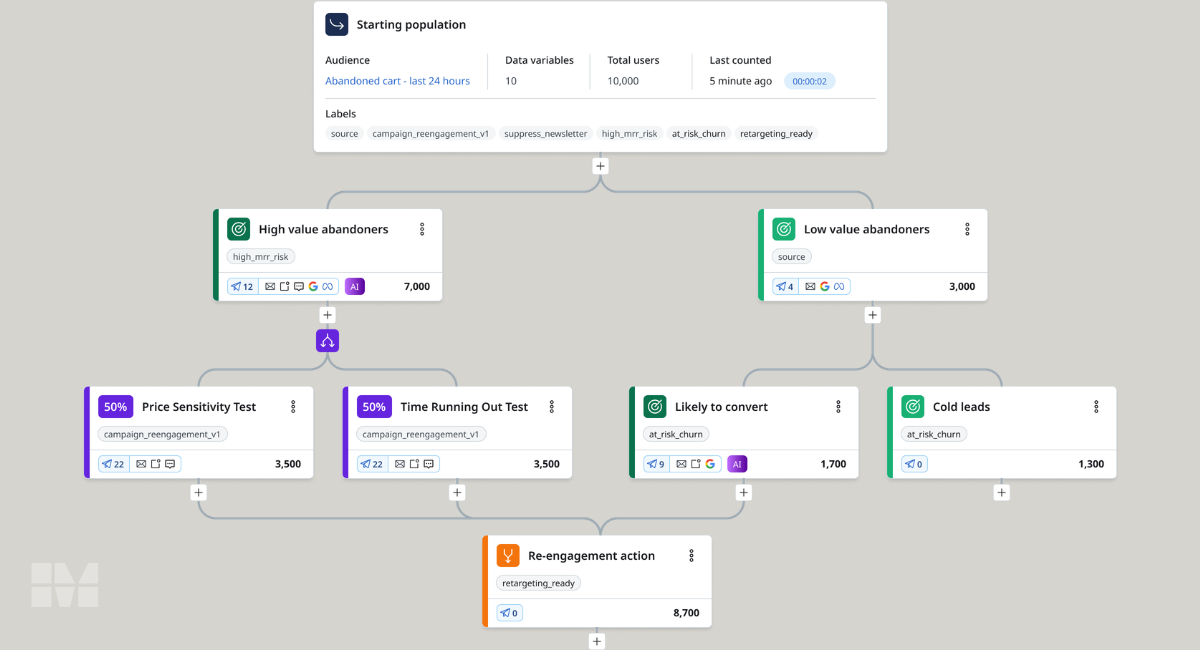
Where they break down is when the logic gets complex. Nested criteria like “loyalty members in the top LTV decile who purchased in the last 30 days, haven’t contacted support in 90 days, and have a predicted churn score above 0.7” often require multi-table joins, window functions, and behavioral event logic. Most journey tools approximate this with workarounds, like pre-built lists, manual exports, or requests to engineering that add days to a campaign timeline.
The result: marketing teams simplify their segmentation logic to match what their tool can do, rather than building the audience that would actually drive the best outcome.
The alternative: Journeys built on top of the data warehouse can run segmentation against your full data model, including multi-table relationships, behavioral history, and complex layered logic. Marketers can orchestrate everything directly from a visual interface without requiring SQL or an engineering ticket.
Limitation #3: Journey triggers depend on stale data
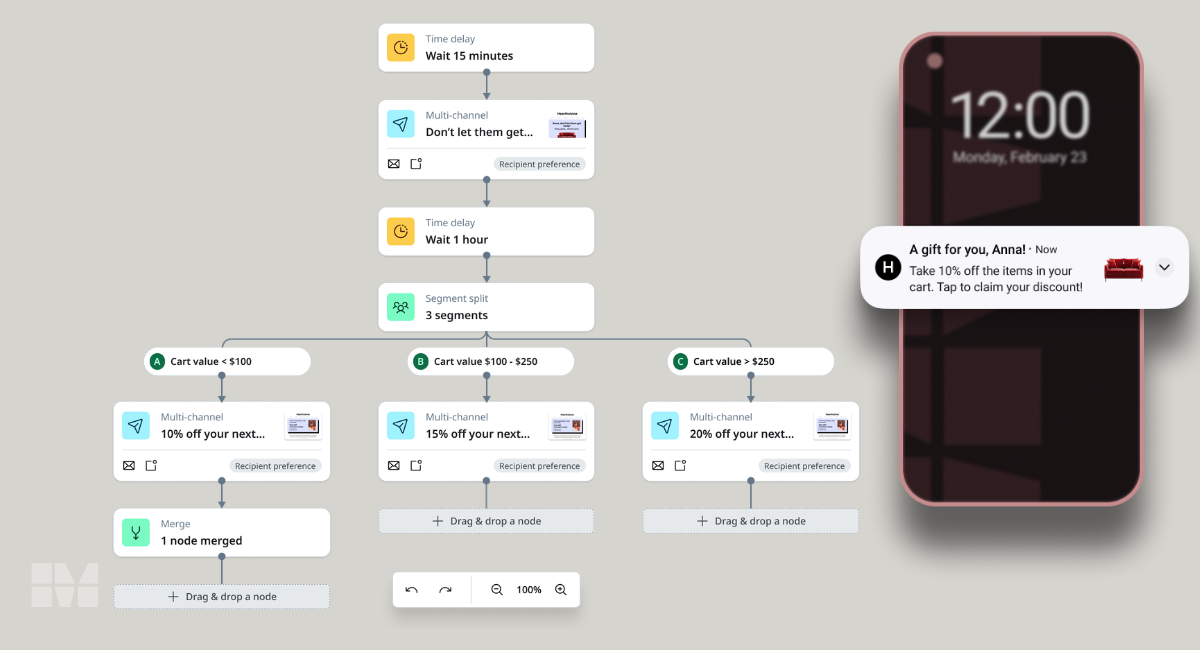
Most omnichannel automation platforms trigger journeys based on events as they know them — which means events as they existed at the last sync. But even a short data lag is enough to miss the conversion window for high-intent moments like cart abandonment, browse behavior, or app activity.
A customer who abandoned a cart two hours ago and has since purchased doesn’t need a recovery email. A customer who browsed a category and then contacted support about a different issue might need a very different follow-up than the one their current journey path would send. When triggers are based on synced data rather than live data, those key distinctions often disappear.
The alternative: Warehouse-native journey automation triggers off live operational data. Aka the same source of truth your data and engineering teams use. No ETL delay. No stale signals. No re-engaging customers who’ve already converted.
Limitation #4: Analytics live in the vendor’s cloud, not yours
Journey analytics dashboards are one of the most heavily marketed features in this category. But vendors are less eager to highlight how the underlying execution data is accessed. Insights like who specifically entered a journey, who branched where, who converted and when — all that typically lives in their cloud, not yours.
This creates a data alignment problem at scale. Your BI team is reporting on conversions from the warehouse. Your marketing team is reporting on conversions from their martech platform dashboard. The numbers rarely match perfectly, and reconciling them costs time, trust, and credibility in executive meetings.
Beyond alignment, keeping journey data in a vendor’s system limits what your analytics and data science teams can do with it. They can’t join it against other datasets. They can’t build custom attribution models against it. They can’t use it to train the next generation of predictive models without an export pipeline… which introduces yet another sync to manage.
The alternative: Journey execution data should automatically write back to your warehouse without an ETL pipeline. When it does, your entire org is working from the same numbers, in the same place. Everyone across marketing, data, finance, and analytics teams is on the same page.
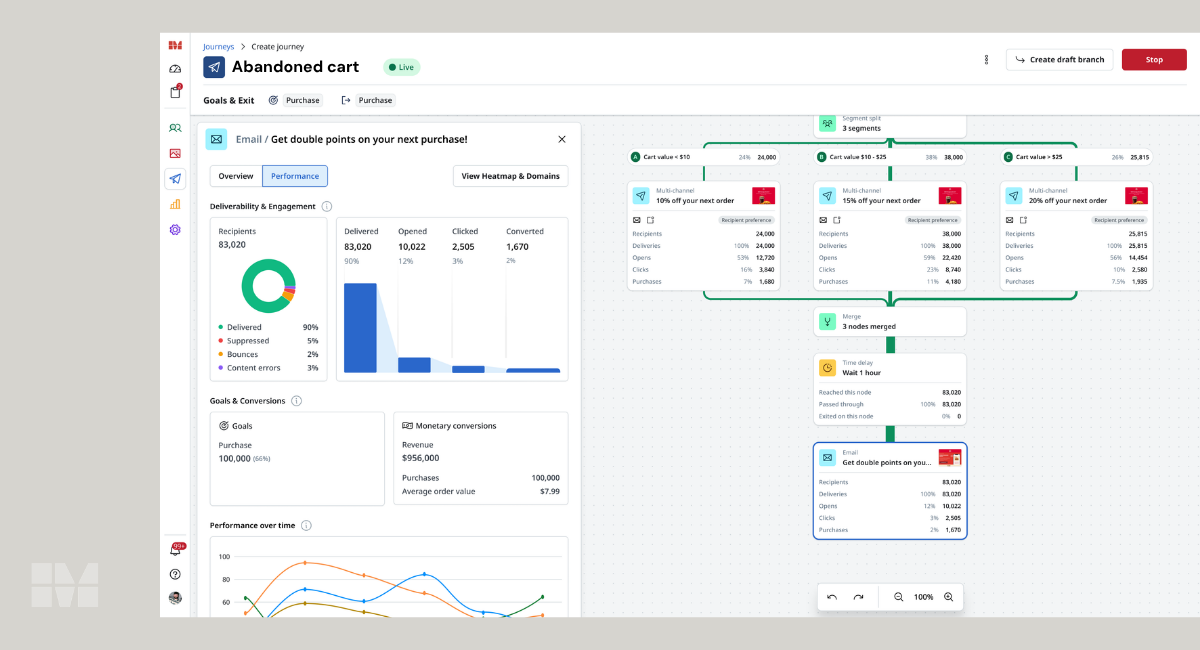
Limitation #5: Experimentation requires rebuilding, not iterating
A/B testing in journey automation is often pitched as a core feature. In practice, multivariate testing within a live journey — adjusting a branch, swapping content, changing timing on a specific node — frequently requires pausing or duplicating the entire flow. That’s not experimentation. That’s overhead.
Enterprise marketing teams running complex, multi-step programs across email, mobile, and other channels need the ability to iterate in-flight. Test a content variant on a specific step, measure it in real time, and double down or cut it without disrupting the rest of the journey.
When testing requires rebuilding, teams test less. When teams test less, performance stagnates.
The alternative: Engagement platforms that support native experimentation enable the kind of continuous optimization that actually moves metrics. Testing nodes embedded directly in the journey canvas, measured at the step level, and adjustable without pausing the flow – that is what marketers need.
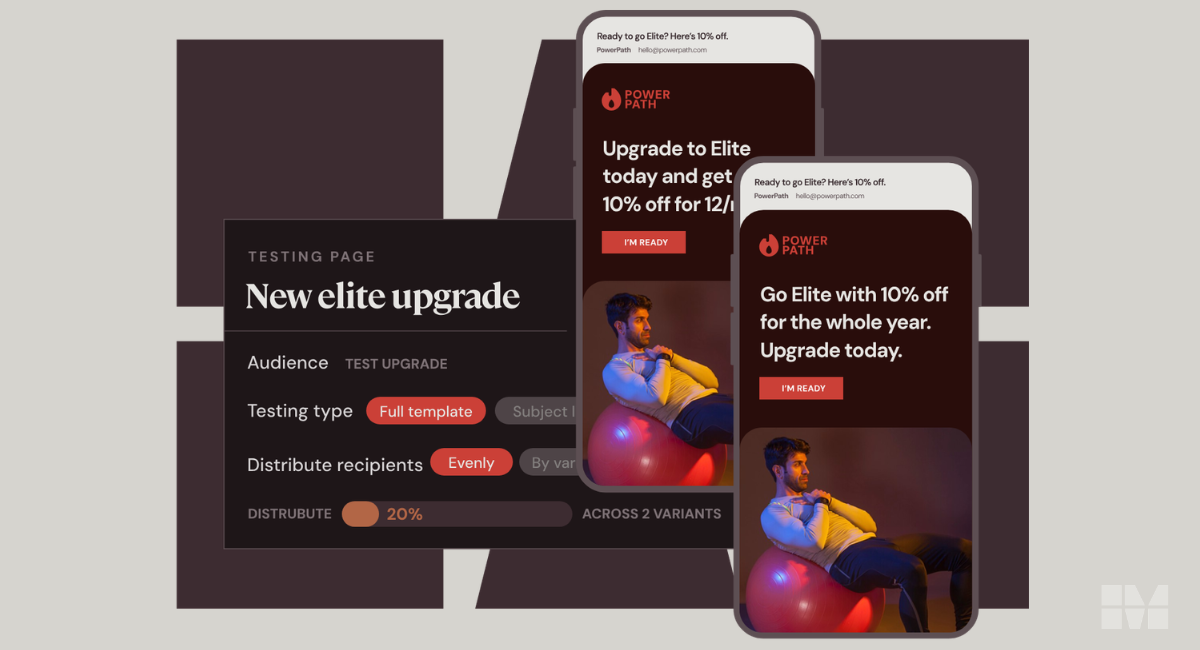
Limitation #6: Marketers depend on engineers for too much
This one is less about architecture and more about workflow design philosophy. The most powerful omnichannel journey tools on the market often require technical resources to unlock their depth. Complex segment logic needs SQL. Journey entry criteria need a data engineer. Attribution analysis needs a BI request.
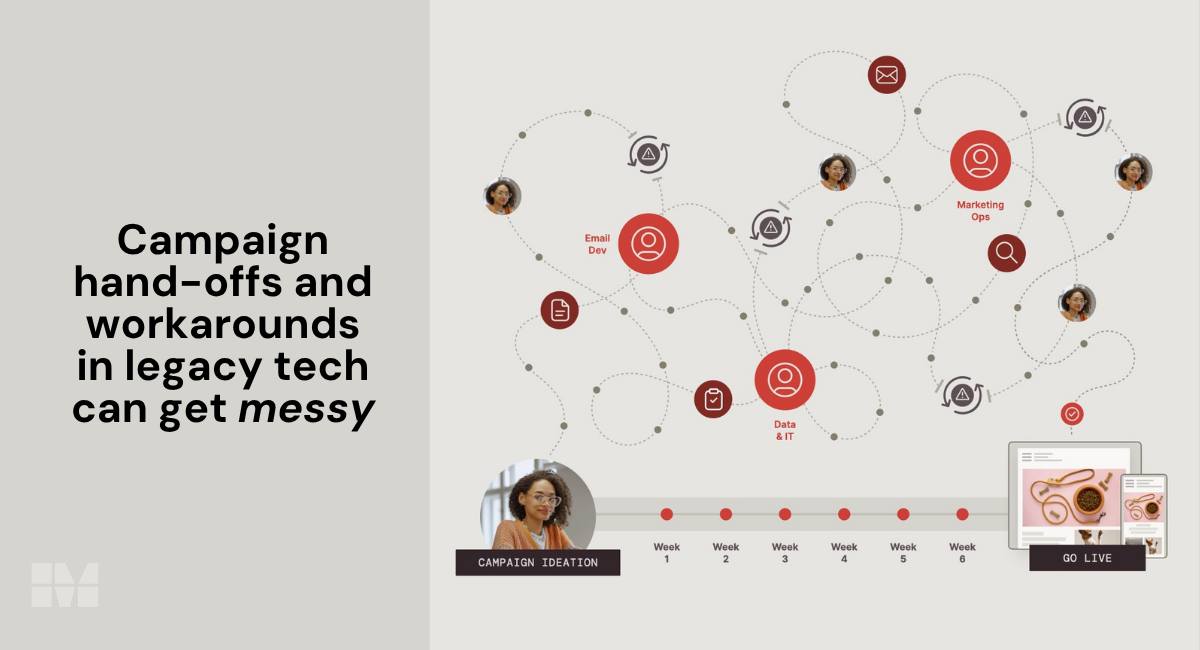
The result is that marketing teams either operate below the platform’s ceiling to stay self-sufficient, or they develop a chronic dependency on engineering capacity that slows every campaign cycle.
The teams that win at journey automation are the ones where marketers can self-serve complexity — not because the tool oversimplifies it, but because the tool’s visual interface doesn’t cap out before the logic does. Engineers should be able to share dataset access that marketers can then slice and dice themselves using a WYSIWYG canvas.
The alternative: Visual builders for both audience segmentation and journey orchestration that expose the full power of the underlying data model through a drag-and-drop interface. Marketers move fast. Engineers stay focused on higher-leverage work.
What overcoming the status quo actually looks like
The limitations above aren’t unsolvable. But solving them at the root (instead of layering workarounds on top of a copied data architecture) requires a different kind of platform. And when most marketing teams are juggling an average of 10 different customer engagement channels, optimizing your martech stack can really save your sanity.
Warehouse-native customer journey orchestration is the clearest path forward for enterprise brands that are invested in modern data infrastructure. If your data lives in Snowflake, Databricks, BigQuery, or a similar platform, the intelligence you need to run sophisticated journeys already exists. The question is whether your customer engagement platform can reach it.
When it can, the ceiling disappears. Personalization has no field cap. Segmentation handles real enterprise logic. Triggers fire on live data. Analytics write back to the source of truth. Marketers self-serve complexity through visual tools. And the teams that have historically been siloed — marketing, data, IT — finally have a reason to align, because they’re all working from the same foundation.
The future of customer engagement is data-native, and that future state is very much in reach. For enterprise brands that have made the shift to warehouse-native orchestration, it’s already how their programs run.
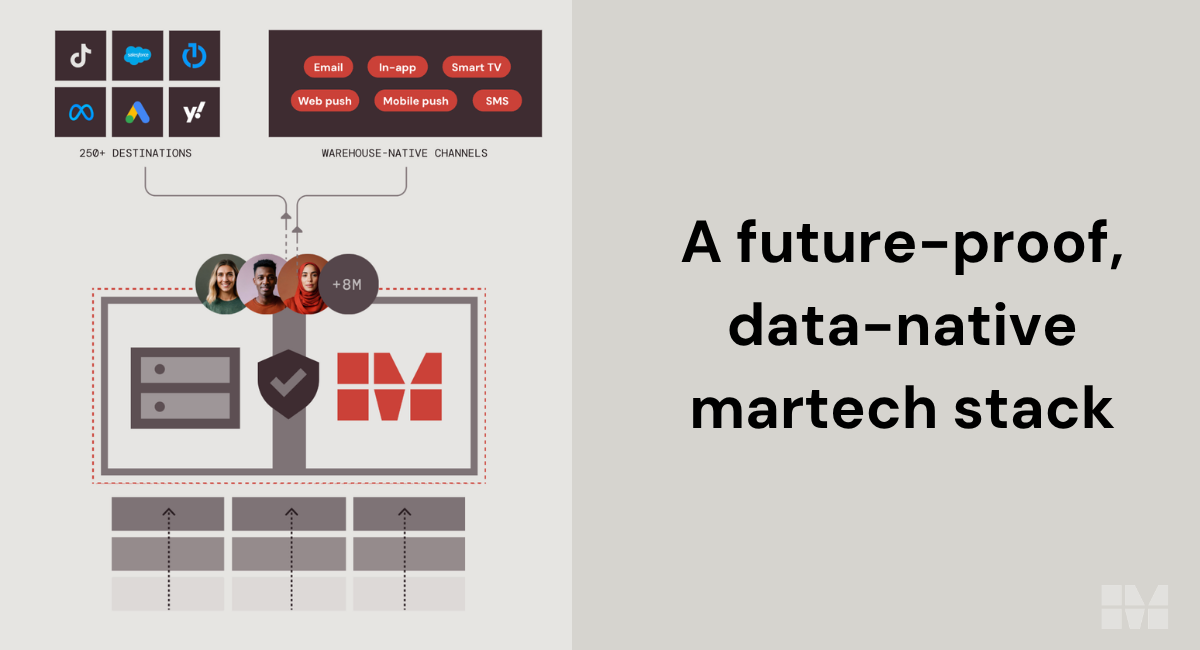
See warehouse-native journey orchestration in action:

Koertni Adams Head of Marketing
Koertni leads marketing strategy across campaigns, channels, and product releases at MessageGears. A lot of her work focuses on educating enterprise teams about the real-time, AI-ready infrastructure that modern customer engagement demands – and why it’s high time to move on from legacy martech systems that feel duct-taped together. With a strong background in content and product marketing, Koertni loves translating jargon into “street speak” everyday language, often finding herself as the link between technical and creative teams. Outside of work, Koertni is a mom of three who spends as much time as she can soaking up the Florida sunshine with her family.